
People talk about “the singularity” as if it were a date in the diary. It is not. In its original sense it is the point at which our models of the future stop working, and that is a more useful idea than the prediction it is usually taken to be.
The term now gets attached to almost anything – superintelligence, mind uploading, the end of work. Taken back to its original meaning, it makes a narrower claim, and one that can actually be tested.
This piece, and the animation that goes with it, sets out what the singularity actually claims, where the argument is strong, and where I think it fails.
Where the word comes from
The word was borrowed from mathematics and physics. In mathematics, a singularity is a point where a function has no defined value. The function 1/x works for every number except zero, where it becomes infinite.
In physics, general relativity predicts infinite density at the centre of a black hole and at the start of the universe. Most physicists read this as a sign that the theory has reached the limit of where it applies, not as a real infinity. A theory of quantum gravity would be needed to say what actually happens there.
Vernor Vinge applied the word to technology in 1993, and he chose it deliberately. His point was not that something becomes infinite. It was that, past a certain point, forecasts built on what we know today stop being reliable.
Exponential is not enough
Most writing on the singularity points to exponential growth. Since Intel’s first microprocessor in 1971, the number of transistors on a chip has doubled about 25 times. The 4004 had around 2,300; the largest chips today hold over 100 billion.
Exponential growth has a property that people underestimate. Each doubling adds more than all previous growth combined, so the latest change always looks larger than everything before it. That is why progress feels sudden even when the rate has been steady for decades.
But an exponential curve never reaches infinity at any finite date. In exponential growth the rate of increase is proportional to the current level. Only if the rate grows faster than the level – with its square, for example – does the curve reach a vertical line at a fixed date. That is called hyperbolic growth, and it is the only kind that produces a true singularity.
The sum that stops at 48
I. J. Good supplied the mechanism in 1965. He argued that a machine able to design a better machine would set off an “intelligence explosion”, because each improvement would speed up the next.
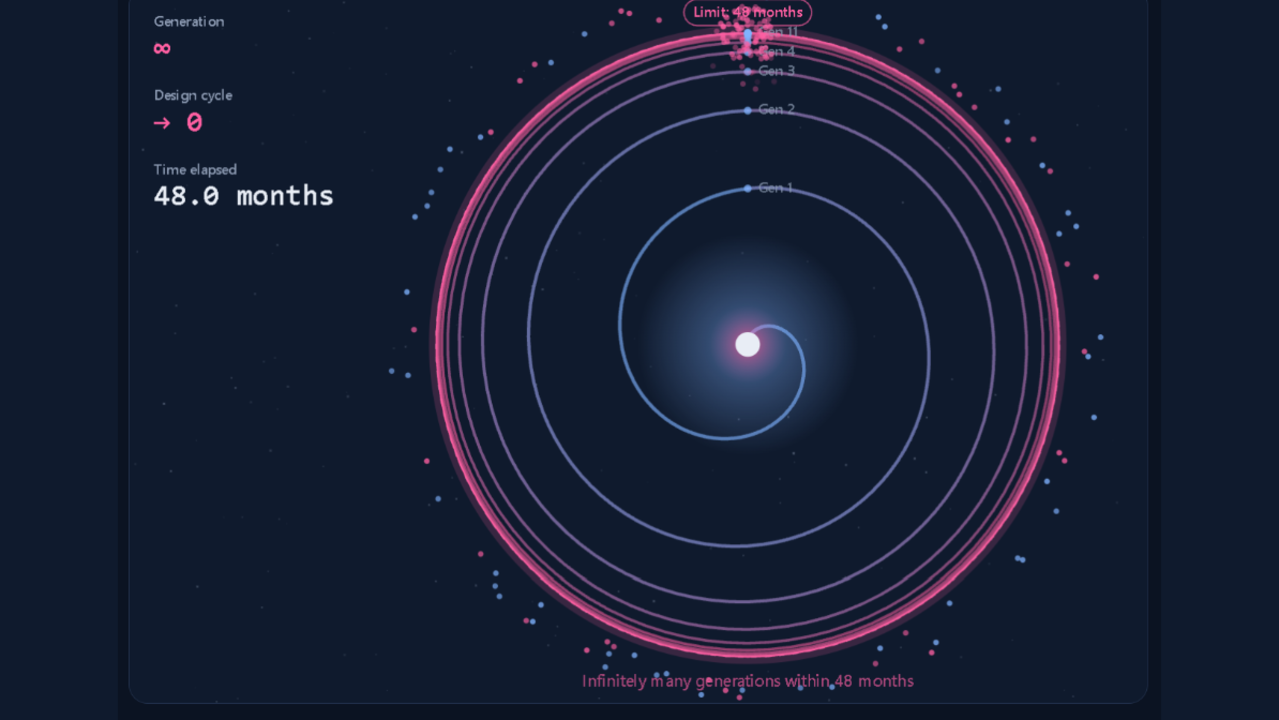
The animation shows this as a spiral. Suppose the first generation of an AI system takes 24 months to design its successor, and each new generation halves the time. The cycles run 24, 12, 6 and 3 months, and so on.
Add those cycles together and the total never exceeds 48 months. There are infinitely many generations, but they all fit within four years. This is a singularity in the strict mathematical sense: an infinite number of steps completed in a finite time.
The whole argument rests on one assumption – that the cycle time keeps halving with no lower limit. Everything that follows depends on whether that is true.
A horizon, not an event
Vinge’s idea is often misread. He did not predict a specific outcome. He predicted that we would lose the ability to predict outcomes.
In the animation, the curve goes vertical and the forecasts beyond that point spread in every direction. Some rise, some level off, some fall. That spread is the point: past the horizon, the methods we use to forecast can no longer separate likely futures from unlikely ones.
Ray Kurzweil puts the date at around 2045, and he has kept to it from his 2005 book to his 2024 follow-up. I treat the date as the least important part of the idea. The useful part is the horizon itself, and the fact that it moves closer as the rate of change increases.
The minimum cycle time
The strongest objection is practical. Each round of improvement needs more chips, more electricity, more training data and more experiments in the physical world. Software can be copied instantly, but none of these can.
This matters because of the 48-month sum. If any step in the cycle has a minimum duration, the halving stops there. Suppose real-world testing always takes at least a week: the system can then complete at most 52 generations a year, and the infinite sum becomes an ordinary long one.
With a minimum cycle time, the curve can still rise exponentially, possibly faster than anything in human history. What it cannot do is reach a vertical line at a fixed date. Add finite supplies of energy and materials, and the growth eventually levels off into an S-shaped curve, which is the second, bounded curve in the animation.
Where the speed-up stops
AI tools are already shortening parts of the development cycle. Design, coding and analysis – the parts made of thinking and typing – now take a fraction of the time they did a few years ago. Other parts have barely changed: building and running hardware, waiting for real users to respond, and finding out what fails in practice.
Amdahl’s law, set out by Gene Amdahl in 1967, says the speed-up of a whole process is limited by the part that cannot be accelerated. If a fifth of a cycle is fixed, the whole cycle can never run more than five times faster, however fast the rest becomes.
Applied to recursive self-improvement, this is the minimum cycle time stated as a number. The question is not whether AI makes design faster – it clearly does. The question is how much of each improvement cycle depends on the physical world, and whether AI can shorten that part too.
What follows
Nobody knows which curve describes the future. Both agree on the next decade or two: progress faster than anything in recorded history. They disagree only on whether there is a ceiling.
The more useful conclusion is narrower. The prediction horizon is real, and it is getting closer whether or not it ever reaches zero. Any long-range plan that assumes today’s tools will still be current is likely to be out of date before it is finished.
The argument also shows where the decisive evidence will appear. If a singularity is coming, the first sign will not be a smarter model but a faster laboratory, factory or data centre – the slow parts of the cycle getting quicker. Until that happens, the bounded curve is the better description of where things are heading.


Leave a Comment